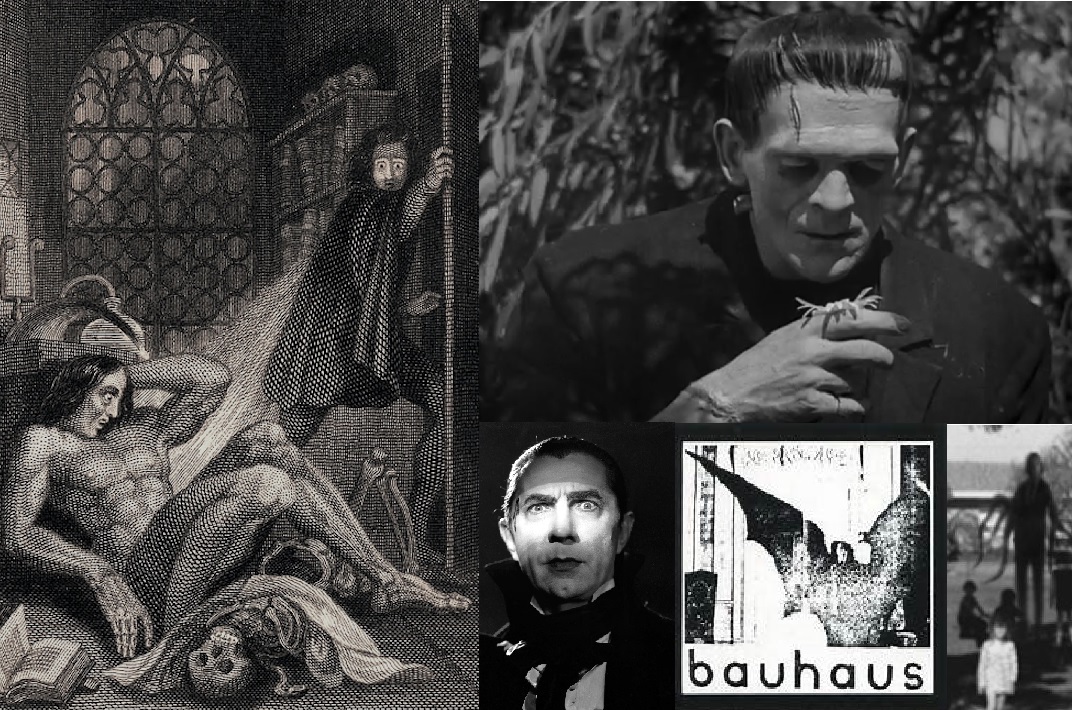
Every year or two I teach English 208G: Gothic Monsters, a course I co-authored with my colleague Tristanne Connolly and which is described in the UWaterloo catalogue as “A study of monstrosity, fear, terror, and horror in the gothic mode from its origins to the present, with attention to the ways various genres (from the novel to new media) represent gothic sexualities, genders, politics, and aesthetics.”
When I teach it, we spend time interpreting and writing about the gothic tradition in several formats including novels, music, and film. Most sessions pair a landmark piece of gothic writing with a musical intertext, for a long history that runs from the eighteenth-century gothic novel to gothic rock. Here’s the draft reading list (subject to change!) for the next offering, which will run in the Winter 2022 term:
- Virginia Woolf, “A Haunted House;” The Cure, “Fear of Ghosts;”
- Isabella Van Elferen, from Gothic Music: The Sounds of the Uncanny; Jeffrey Cohen, “Monster Theory”
- Horace Walpole, from The Castle of Otranto; Matthew Lewis, from The Monk; Fields of the Nephilim, “Preacher Man;” Christian Death, “Cavity-First Communion”
- Anne Radcliffe, from The Romance of the Forest. The Cure, “A Forest”
- Mary Shelley, Frankenstein, vol. 1; Southern Death Cult, “Vivisection”
- Frankenstein, vol. 2; Siouxsie and the Banshees, “Hybrid;” Virgin Prunes, “Decline and Fall”
- Frankenstein, vol. 3; Sisters of Mercy, “Black Planet”
- Sigmund Freud, from “The Uncanny;” Julia Kristeva, from Powers of Horror
- Bram Stoker, Dracula, first half; The Birthday Party, “Release the Bats”
- Bram Stoker, Dracula, second half; Nick Groom, from The Vampire: A New History
- Tod Browning, Dracula (1931); Bauhaus, “Bela Lugosi’s Dead”
- Susan Sontag, from Notes on Camp; Laura Mulvey, from Death 24x a Second
- George Romero, Night of the Living Dead (1968)
- Anne Rice, Interview with the Vampire; Diamanda Galás, “This Is the Law of the Plague”
- Marble Hornets (Youtube series); The Birthday Party, “Deep in the Woods”
- Kate Pullinger, Breathe (“locative media” smartphone novel); “Gothic Adventures in Sound” (British Library field recording site); Michael Gallagher, “Sounding Ruins”
 John Savarese