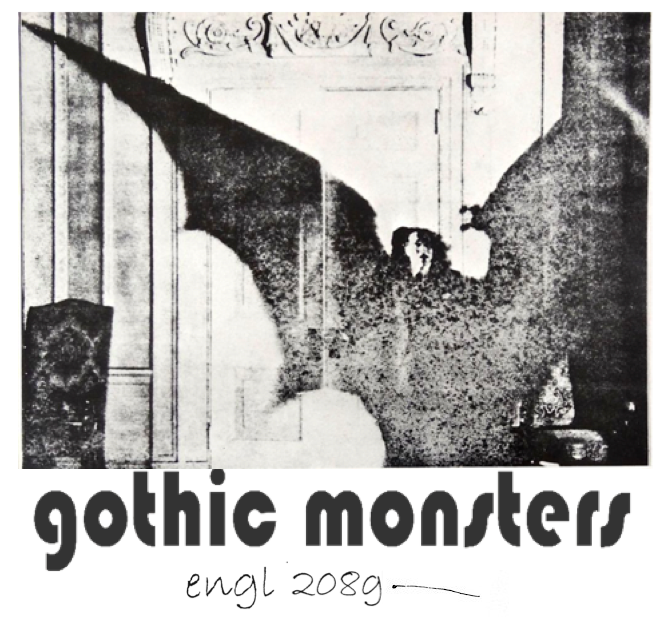
For Winter 2025 I’ll be teaching ENGL 208G: Gothic Monsters. In this course, we spend time interpreting and writing about the gothic tradition in several formats including novels, music, and film. Most sessions pair piece of gothic writing or film with a musical intertext, which creates a parallel pathway for students interested in an introduction to goth music and culture.
This time around, we will begin with a series of foundational gothic texts and the monsters they work with–“monster” as omen or portent; and figures of the ghostly, disembodied spirit and the physical, animated, or “undead” body (explored in very different ways in the classic texts Frankenstein and Dracula). The second half of the course will look at the afterlives of those figures in more recent literature and media, with particular focus on the “gothic double” or the “doppelgänger,” considered both as a type of eerie or monstrous figure, and as an important narrative pattern in gothic horror and beyond.
Here’s the draft reading list (subject to change!) for the next offering, which will run in the Winter 2022 term:
Reading List:
- Virginia Woolf, A Haunted House; Matthew Lewis, “Alonzo the Brave and the Fair Imogine;” Jeffrey Cohen, “Monster Culture: Seven Theses”
- Horace Walpole, The Castle of Otranto; The Cure, “The Holy Hour”
- Excerpts from Matthew Lewis, The Monk and Ann Radcliffe, The Italian; Christian Death: “Cavity-First Communion”
- Mary Shelley, Frankenstein; Southern Death Cult, ‘Vivisection;” Virgin Prunes, “Decline and Fall;” Siouxsie and the Banshees, “Hybrid;” Sisters of Mercy, “Black Planet”
- Sigmund Freud, from The Uncanny; Julia Kristeva, from Powers of Horror; Siouxsie and the Banshees, “Premature Burial”
- Bram Stoker, Dracula; The Birthday Party, “Release the Bats”
- Dracula (1931)
- Bauhaus, “Bela Lugosi’s Dead;” “Mask” (music video); Laura Mulvey, from Death 24x a Second
- Charles Addams, select one-panel comics; Edward Gorey, from The Gashlycrumb Tinies; “The Addams Family Meet the VIPs” (tv episode)
- Edward Scissorhands (1990); The Cure, “Cold;” “The Last Dance”
- Mary Shelley, “Transformation;” Edgar Allan Poe, “William Wilson;” Robert Louis Stevenson, from The Strange Case of Dr. Jekyll and Mr. Hyde; Ellie Violet Bramley, “Why We’re Living in the Golden Age of the Doppelgänger”
- Us (2019)
- Kate Pullinger, Breathe (“locative” smartphone novel); Sara Watson, “Data Doppelgängers and the Uncanny Valley of Personalization;” Siouxsie and the Banshees, “Monitor”
- Silvia Moreno-Garcia, Mexican Gothic; Twin Tribes, ‘Fantasmas;” author-curated playlist for the book
- Additional concluding texts to be selected by the class

 John Savarese